
Smart homes in India — the IoT-ready interior playbook.
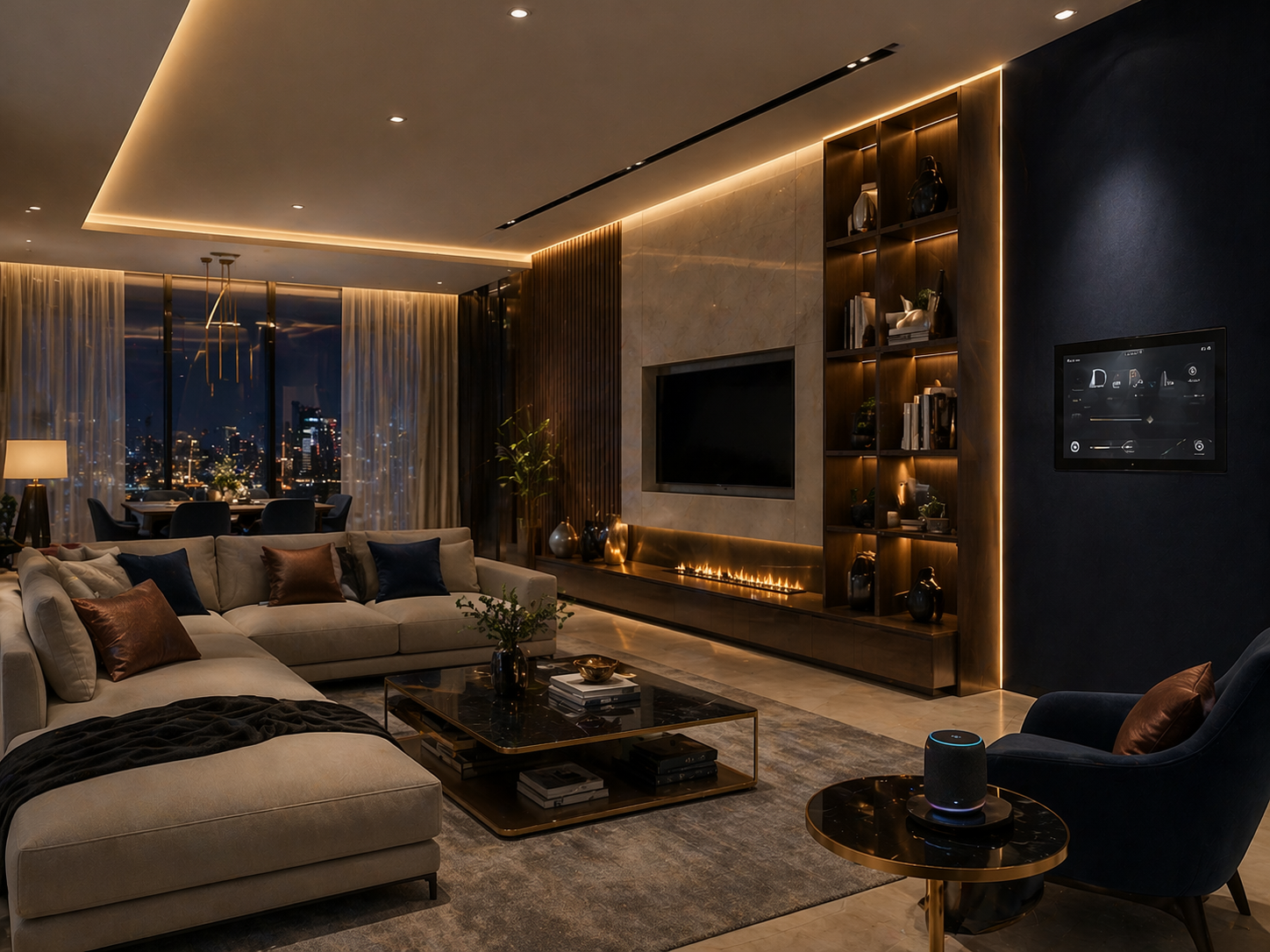
The Indian smart home market is moving from "luxury add-on" to "expected fit-out," and homeowners now arrive at the first design meeting asking about lighting scenes, voice control, security integration and energy dashboards. The challenge is not the technology — most of it works. The challenge is integrating it without the home looking like a control room or behaving like one. The right outcome is a home where automation is everywhere and visible nowhere.
The principle: invisible by default
Good smart homes follow a simple principle: the technology should disappear into the architecture. No exposed sensor housings on a feature wall. No keypad shouting on the entry. No hub LED visible from the dining table. Every device finds a home that the design has anticipated for it. This is only possible when automation is brought into the project early — at the layout stage, not the FF&E stage.
The seven systems we plan from day one
- Lighting control: circuits zoned by mood, scenes per room, dawn-to-dusk profiles
- Climate: zoned HVAC, humidity sensors, air-quality awareness
- Security: access control, surveillance, perimeter and door sensors
- AV: multi-room audio, hidden speakers, projector and TV integration
- Window treatment: motorised blinds, programmable shading
- Voice + scene control: on the wall, in the hand, and over the air
- Energy & metering: circuit-level visibility for HNI clients
If your switch plate has more than three buttons on it, the design has lost.
The cabling matrix is the real document
Behind every well-automated home is an unglamorous spreadsheet — the cabling and conduit matrix. It is what keeps the joinery joinery, the ceiling clean, the wall clean and the technology functional. Cabling is one of the few decisions that you cannot reverse without breaking things, so it has to be planned with the same seriousness as a beam or a column.
What changes once it is in
Clients underestimate how a well-designed smart home changes the rhythm of life inside it. Lights respond to the time of day. The bedroom prepares itself before they enter. The morning scene comes on with the curtains. None of this is gadgetry — it is the design of how the home meets the day. When automation is invisible and intelligent, it stops being technology and starts being atmosphere.