
AR / VR in design — from walkthrough to client confidence.
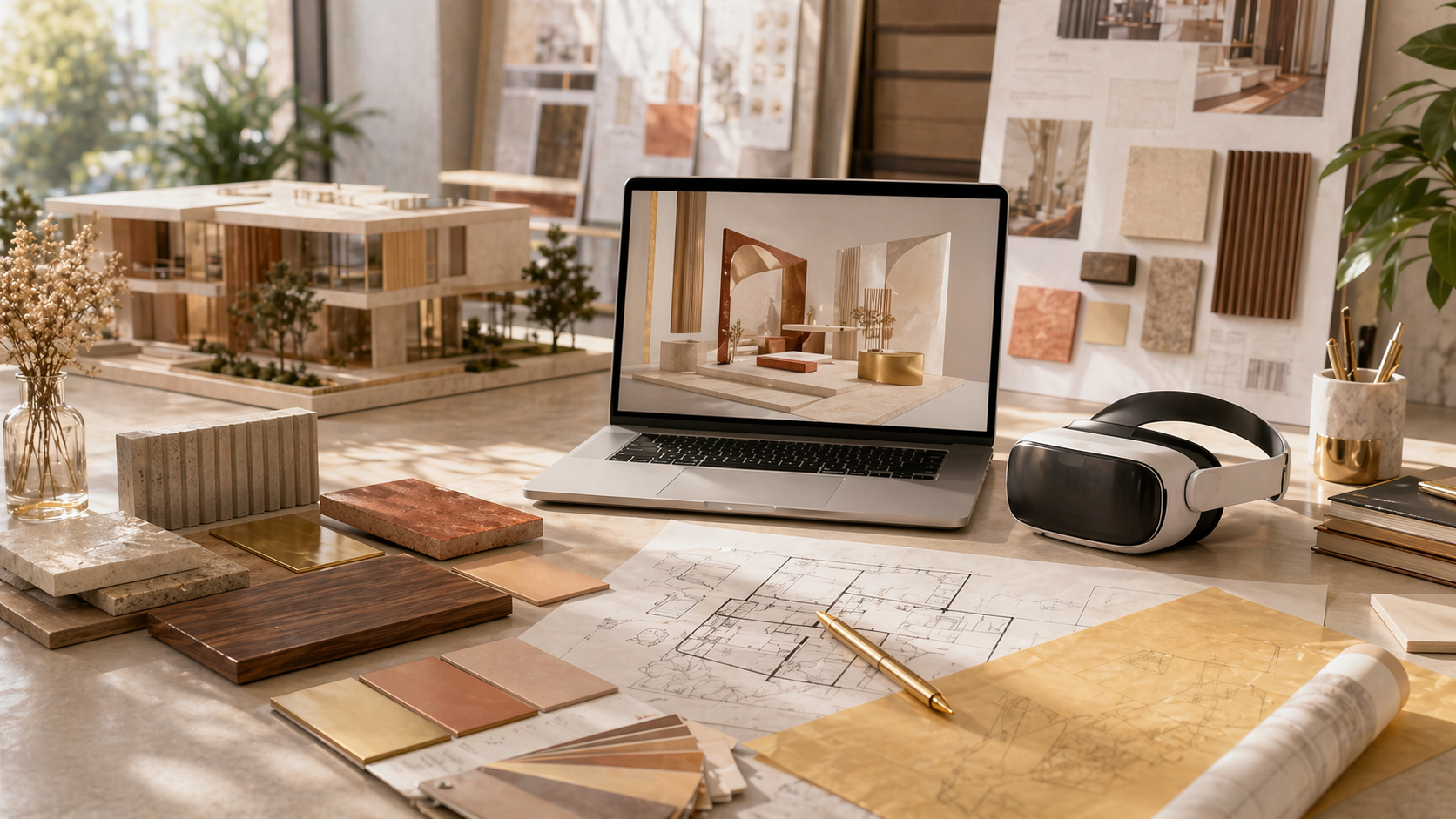
For a long time, visualisation was a sales tool. You produced two or three rendered views, the client approved a direction, and construction began with a fair amount of imagination still required on both sides. AR and VR have changed that conversation. A walkthrough at one-to-one scale before a wall is built does not just impress the client — it removes uncertainty from the project, tightens decisions earlier, and changes the entire delivery economics of the project.
The three things VR removes
- Scale doubt: the client finally understands what 3.2 metres of ceiling really feels like
- Material doubt: a stone palette tested in VR settles in three minutes what would take three site visits
- Sequence doubt: walking the space before it exists reveals flow problems no plan will
The walkthrough is the new approval drawing.
What AR adds at site
AR shines when the building exists but the interior does not. A client standing inside a structural shell can see the joinery laid over the wall through a tablet, the lighting curve overlaid on the ceiling, the flooring transition mapped onto the slab. Confidence is built faster, and the conversations on site become specific instead of speculative. AR has changed the value of a site visit — it now produces decisions, not just observations.
Where it does not replace anything
VR and AR are powerful, but they do not replace good detailing. A walkthrough cannot fix a poorly-detailed plan, only reveal it sooner. A render does not write specifications. The studios that get the most from AR and VR are the ones whose underlying design discipline is already strong; the technology then becomes an amplifier, not a crutch.
The client outcome
The deepest change AR and VR bring is psychological. Clients arrive at construction with confidence, not anxiety. Decisions get locked in earlier and stay locked in. The cost of late changes drops sharply. The architect-client relationship moves from "trust me, it will look like this" to "you have already walked the room — let's build it." That, more than any single render, is what visualisation has actually given our practice.