
Designing hospitality spaces that build memory.
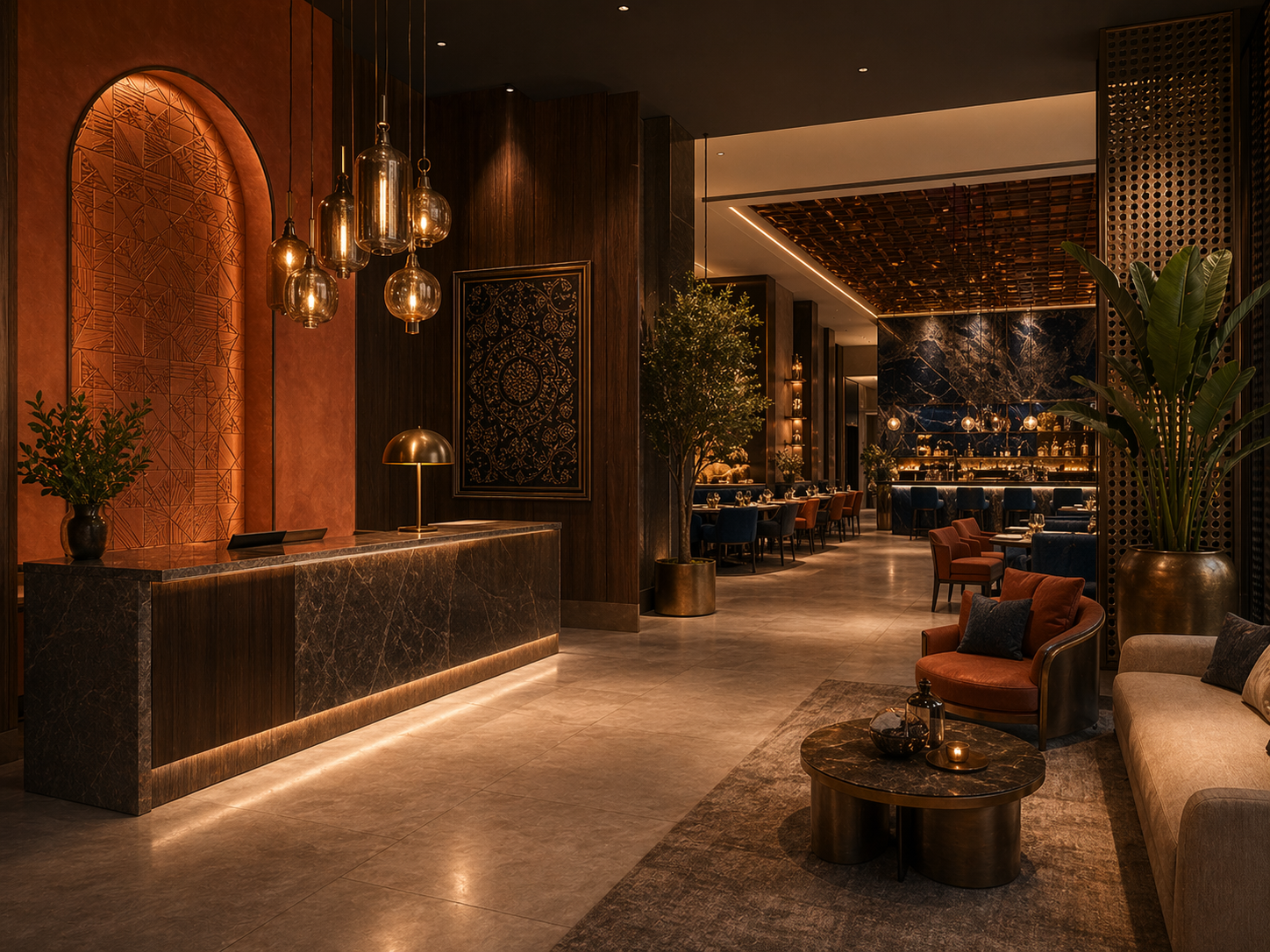
People do not remember restaurants. They remember dinners. They do not remember hotels. They remember a particular bath at the end of a long flight, the smell of the corridor, the way the morning light fell across the breakfast table. Hospitality design is, at its heart, a memory exercise. Every plan, every material, every lighting curve is a quiet question: what will this space leave behind?
Sequence is the brief
The single most under-discussed tool in hospitality design is sequence — the order in which a guest experiences a space, the rhythm of compression and release as they walk through it, the way one room hands them off to the next. A hotel that begins with a low-ceilinged porte-cochère, opens into a tall lobby, and then narrows down a softly-lit corridor before delivering you to your room is doing something very deliberate. It is teaching you to slow down.
The five layers we always design
- Light: Layered — ambient, accent, task, decorative — and dimmable across day-parts
- Sound: Acoustic dampening, music zoning, the quiet hum of ventilation
- Smell: Signature scent cues at thresholds, never ambient over-perfume
- Touch: Natural materials at points of human contact — handles, balustrades, table edges
- Sight: Long views, framed moments, and never an unintentional dead-end
Hospitality is not a style. It is the design of warmth under pressure.
The operations test
A hospitality space has to look beautiful at six in the evening and be runnable at eleven in the morning, when the housekeeping cart is in the corridor and three guests are checking in late. We design spaces that pass the operations test: service routes that don't collide with guest routes, finishes that age well under industrial cleaning, joinery that allows easy access to MEP for the engineering team without anyone seeing a service hatch. The most luxurious hotel is the one where the back-of-house never spills into the front-of-house.
Memory is built from contrast
Guests don't remember rooms that are uniformly excellent. They remember moments that contrast — the dim corridor that opens into a sunlit suite, the formal lobby that gives way to an intimate bar, the loud restaurant whose private dining room feels like another world. A hospitality space designed entirely on one note may be polished, but it will not be remembered. Build contrast into the journey, and the journey will travel with the guest after they leave.